
Most people who come to Scottsdale looking for a home already have a reasonably good idea of why they want to be here. They’ve visited in winter, enjoyed the sunshine, played a few rounds of golf, had amazing hikes and started imagining what it would be like to make Arizona a more permanent part of their lives.
What they don’t always know is where in Scottsdale they should be looking.
That’s an important distinction.
Having worked in Arizona luxury real estate for more than two decades, and living in North Scottsdale myself, I’ve come to appreciate how different the experience can be from one neighborhood to the next.
A home in Silverleaf, a condominium near the Waterfront, and a property in Desert Mountain might all appeal to a person relocating from Chicago or California. They offer three quite different ways of living.
The interesting question isn’t why people continue to choose Scottsdale. It’s what they’re hoping to find when they get here, and whether the home they’re considering will actually deliver it.
Why Does Scottsdale Appeal to So Many Out-of-State Buyers?
The climate is the starting point, but the real draw is that Scottsdale works as a place to live rather than only a place to escape to.
The weather is the obvious attraction, particularly for buyers arriving from places with long winters. I think the appeal goes further than that.
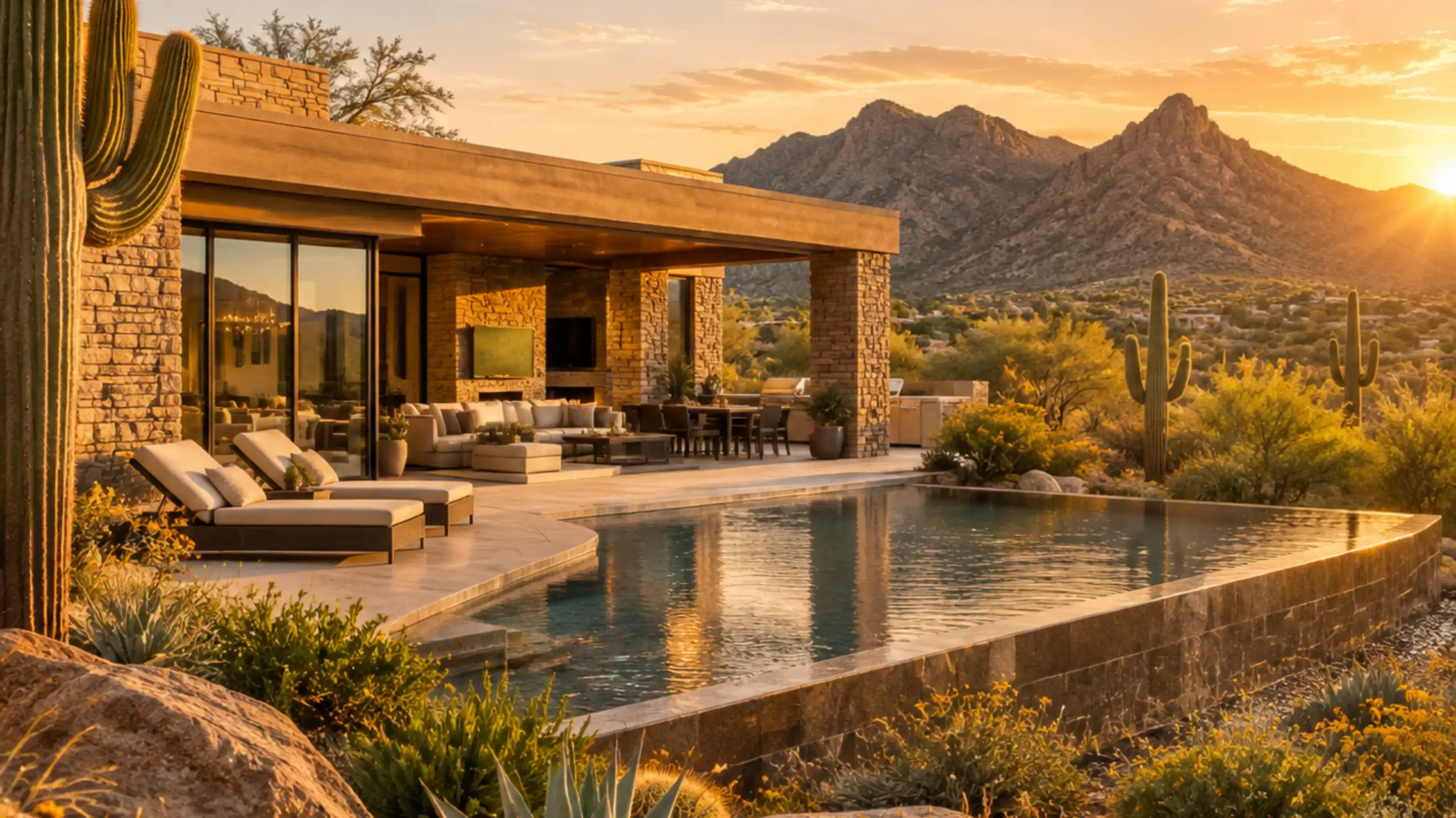
There’s the opportunity to spend more time outdoors, enjoy a greater sense of space, and live somewhere the natural landscape is part of the everyday experience rather than a weekend destination. In North Scottsdale, the McDowell Mountains and the Sonoran Desert are never far away. Golf, hiking, cycling and outdoor entertaining become regular activities rather than something saved for a vacation.
But the practical side matters too. Phoenix Sky Harbor connects the Valley to destinations across the country and overseas, and Scottsdale Airport handles a considerable volume of private aviation, which is a genuine consideration for buyers in the northern communities. There’s excellent dining, shopping and healthcare, and a growing metropolitan area surrounding the quieter residential pockets.
The result is an appealing balance: privacy and desert surroundings without feeling entirely removed from the conveniences of a major city.
That balance changes considerably depending on where you buy.
North Scottsdale, Central Scottsdale, or Old Town: Where Should You Begin?
Choose the neighborhood before you fall in love with the house. Scottsdale stretches a long way north to south, and the differences between its communities are far more significant than a map suggests.
What Is North Scottsdale Like for Luxury Buyers?
North Scottsdale suits buyers who want mountain views, often but not always, larger parcels, golf, and a quieter residential setting — though there’s considerable variation even within it.
DC Ranch has a well-established community structure, attractive villages, and convenient access to Market Street with its restaurants and everyday amenities.
Silverleaf sits within DC Ranch but offers something quite different. Set into the McDowell Mountain foothills, it’s known for its private, guard-gated setting, custom homes, the Tom Weiskopf-designed golf course, and the Silverleaf Club.
Farther north, Desert Mountain sits in high Sonoran Desert, with a club that includes six Jack Nicklaus Signature courses and a seventh, a par-54 layout known as No. 7, along with clubhouses, restaurants and miles of private trails. Its higher elevation makes a noticeable difference in summer.
For someone who intends to spend much of their time golfing, hiking, or simply enjoying the desert, that setting is hard to beat.
But if you fly out of Sky Harbor regularly, enjoy spontaneous dinners in Old Town, or like having shops close to home, the additional distance may matter more than you expect.
It’s worth remembering that a spectacular setting and a convenient location aren’t necessarily the same thing.
Is Central Scottsdale a Good Compromise?
Central Scottsdale appeals to buyers who want an established neighborhood with everyday amenities nearby, without the drive times of the far north.
McCormick Ranch and Gainey Ranch are the obvious examples, though their housing stock and ownership structures differ meaningfully.
Gainey Ranch and McCormick Ranch are particularly interesting for seasonal residents, and made up of a number of distinct enclaves. Patio homes, townhomes and single-family residences arranged around lakes, greenbelts and, in Gainey Ranch, the golf course
One detail worth knowing: in most of the Valley’s golf communities, club membership is offered separately from HOA dues, often in tiers and sometimes with limited availability, so it’s worth confirming rather than assuming.
As I’ve written in more detail in my guide to whether Gainey Ranch is the right lock-and-leave community for you, not every enclave within a named community offers the same level of maintenance or ownership convenience. Which is precisely why I recommend looking past the name on the entrance sign.
What Do Old Town and the Waterfront Offer?
For some buyers the attraction is A heady combination of being on the doorstep of the self-proclaimed West’s most Western town, on the south side of the Waterfront, to being close to excellent restaurants, galleries, the extraordinary shopping experience of Fashion Square on the north side. Old Town Scottsdale and the Waterfront deliver a more urban experience, including The Waterfront Residences. Luxury condominiums that suit second-home buyers particularly well.
What Is Living in Scottsdale Like Beyond the Winter Season?
Visiting in February tells you very little about July, and the difference affects both daily life and how occupied your street feels.
A winter visit is a wonderful introduction. Comfortable temperatures, busy golf courses, full patios.
The Scottsdale season, a mix of The Waste Management Golf Open, Barrett Jackson Car Auctions, and, of course, Cactus League, that presents the city at its most appealing.
That’s one part of the picture.
Arizona summers are hot and daily routines change accordingly. Outdoor activity moves to the early morning. Shaded patios, pools and well-designed indoor spaces become considerably more valuable than they looked in January.
In some North Scottsdale communities, many homes are seasonal residences. A neighborhood that feels lively in February can be noticeably quiet in July. For some owners that’s an advantage. The peace, the lighter traffic. Others would rather more of their neighbors lived here year-round. It’s worth asking the question before you buy rather than discovering the answer in your first summer.
I’d also encourage buyers to pay attention to something that rarely comes up during a showing: the orientation of the house.
An impressive wall of glass facing west is beautiful at sunset and introduces a great deal of afternoon heat. Nobody has ever fallen in love with a house because of its roof overhang, until they move to Scottsdale. It’s what Frank Lloyd Wright mastered. How a patio is shaded, where the outdoor spaces sit, and how the cooling system performs will nonetheless determine how much of the year you actually use the outside of your home.
These aren’t the details that sell a house in February. They are the ones you live with in July.
How Much Privacy Are You Actually Buying in North Scottsdale?
A gated entrance, a large lot, and protected surrounding land are three different kinds of privacy, and buyers routinely confuse them.
A guard-gated community controls access. A larger parcel creates physical separation. The positioning of the house, its landscaping and its sightlines determine how secluded the living spaces actually feel.
After twenty years of walking buyers around North Scottsdale lots, the pattern I’ve come to expect is that acreage and privacy correlate far more loosely than people assume. I’ve stood in the back of a half-acre property that felt entirely sealed off because the house was set at an angle and the wash behind it was undevelopable, and I’ve stood on three acres where a neighbor’s second storey looked directly into the pool. The lot size was on both listings. The NAOS (Natural area of open space. It’s very much a Scottsdale thing.), wasn’t mentioned. Neither listing mentioned the thing that actually mattered.
There’s a further consideration that deserves more attention than it usually gets: what happens to the land around the property.
The McDowell Sonoran Preserve permanently protects a large area of desert across the north of the city. Scottsdale’s Environmentally Sensitive Lands Ordinance also regulates development across large parts of the north, requiring portions of private development sites to be preserved as Natural Area Open Space depending on the land’s characteristics.
That offers meaningful protection for the surrounding desert.
It does not mean every mountain view or vacant parcel in North Scottsdale is safe from future development.
A home overlooking permanently preserved land is a different proposition from one overlooking an ordinary vacant lot. And even where open-space restrictions apply, they don’t automatically guarantee a particular view stays unobstructed.
If you’re paying a premium for privacy or scenery, establish the precise status of the surrounding land before you make an offer. It’s a small part of the process with a lasting effect on how you feel about the property.
Why Isn’t the Most Expensive Home Always the Best Purchase?
Because price per square foot tells you almost nothing about the things you can’t change.
Consider two homes with similar interior space and similar asking prices. One has exceptional mountain views, a genuinely private lot, and an architectural design that makes the most of its setting. The other has a beautifully updated interior on a less desirable orientation with closer neighbors.
On paper they look comparable. In practice their appeal and their resale prospects may be quite different.
When I evaluate a luxury property, I pay particular attention to whatever would be difficult or impossible to reproduce. You can renovate a kitchen, modernize bathrooms, replace flooring, redesign an interior. You cannot move the lot, relocate the mountains, or create separation from neighboring homes if the site doesn’t allow it.
That doesn’t make improvements unimportant. A well-maintained, thoughtfully updated home will always make a stronger impression than one needing significant work. But location, lot quality, architecture and privacy deserve as much attention as the finishes.
For anyone thinking about long-term value, understanding that difference is considerably more useful than comparing square footage.
Is Buying a Scottsdale Second Home Different From Buying a Primary Residence?
Very much so, and the difference is less about the house than about what ownership involves when you aren’t there.
A property that would suit a full-time resident isn’t necessarily practical for someone spending four or five months a year in Arizona.
Who looks after the landscaping? Who checks the property after a summer storm? How is the pool maintained? What happens if an air-conditioning system fails while you’re in Chicago?
These are the everyday realities of owning a seasonal home in the desert.
For buyers who want fewer responsibilities, a condominium or patio home in a managed community can be a far better answer than a detached property.
I’ve sold more than $300 million of mid- and high-rise condominiums across Scottsdale, the Biltmore and Phoenix, and the clearest lesson from all of it is that the building matters as much as the residence.
Beautiful interiors are easy to appreciate on a tour. The financial health and management of an association take rather more work to assess. I want to understand reserves, maintenance history, planned capital improvements, rental rules, and exactly what the monthly assessments cover.
If I had to name the single document that has changed the most minds in my transactions, it’s the reserve study. Buyers arrive focused on the view and the finishes, read the reserve study, and discover that the building is three years away from a roof or an elevator modernization that nobody has funded. That isn’t necessarily a reason to walk away — it’s a reason to know what you’re walking into, and often a reason to revisit the price.
The right second home should be enjoyable when you’re here and manageable when you’re not.
What Does Scottsdale’s Popularity Mean for Sellers?
It means knowing which buyer your particular property is for, because they aren’t all looking for the same thing.
Someone searching in Silverleaf may prize architectural quality, privacy and mountain views. A buyer considering DC Ranch could care more about established amenities, village character and proximity to shops and restaurants. A seasonal buyer looking at a Waterfront condominium is probably focused on convenience, security and the ability to leave for months at a time.
Those differences should shape how a property is priced, presented and marketed.
Sellers also need to be selective about improvements before listing. It’s tempting to assume a new kitchen will automatically return its cost. Sometimes it does. Sometimes the money is better spent on deferred maintenance, on presentation, or on simply recognizing that the property’s strongest asset already exists — a well-positioned lot, an exceptional view, a particularly good location within a community.
The objective is to understand what today’s buyers will value about that specific property, rather than preparing every luxury home the same way.
How Do You Decide Whether Scottsdale Is Right for You?
It depends entirely on how you intend to live here, which is why I’d spend time on the neighborhood before the house.
I understand why people are drawn to this area. After living and working in North Scottsdale, I still appreciate the landscape, the time outdoors, and the variety of communities on offer.
I wouldn’t suggest that Scottsdale, or any particular neighborhood within it, is automatically right for everyone.
Someone who likes restaurants within walking distance will be happier near Old Town than in a secluded golf community. A buyer looking for a quiet desert retreat will feel exactly the opposite. And someone purchasing a second home faces an entirely different set of practical questions from a family relocating full-time.
Drive the routes you’ll actually use. Visit at different times of day. Consider what the community feels like outside the winter season. And take the time to understand the things that aren’t obvious from a listing photograph.
Scottsdale offers some exceptional opportunities. The right decision is finding the property that works for you, not the one that makes the strongest first impression.
If you’re considering a move to Scottsdale, or looking at a different home within the Valley, I’d be glad to share what I’ve learned and help you work out which communities might suit.
Frequently Asked Questions
Why are people relocating to Scottsdale?
Buyers are drawn by the warm climate, the outdoor lifestyle, established luxury communities, and access to the greater Phoenix area. The range of residential settings — from private desert estates to urban condominiums — lets buyers choose a lifestyle rather than just a house.
Is North Scottsdale better than Central Scottsdale?
Neither is inherently better. North Scottsdale generally offers desert-oriented living, mountain views and private golf communities. Central Scottsdale offers more convenient access to shopping, restaurants and established amenities. The right choice depends on your everyday routine, not on prestige.
What should out-of-state buyers consider before purchasing in Scottsdale?
Beyond the home itself: sun exposure and orientation, realistic driving distances, property maintenance while you’re away, HOA responsibilities, and the status of the surrounding land. Visiting in more than one season is the single most useful thing you can do.
Are desert and mountain views protected in Scottsdale?
Some surrounding land is protected through the McDowell Sonoran Preserve or designated as Natural Area Open Space under the city’s Environmentally Sensitive Lands Ordinance. Not every desert view is protected, and restrictions on neighboring land do not guarantee an unobstructed view. Review the specific parcels before purchasing.
Does buying in a Scottsdale golf community include club membership?
Usually not. Most Valley golf communities, including Gainey Ranch, offer membership separately from HOA dues, often in tiers and sometimes with a waiting list. Confirm membership type, cost and availability in writing before you rely on it.
Is Scottsdale a good place to buy a second home?
It offers a wide range of options for seasonal owners — managed condominium buildings, patio homes and guard-gated communities. The best choice depends on how often you’ll visit, how much maintenance you’re willing to manage remotely, and what you want your time here to look like.
Social Cookies
Social Cookies are used to enable you to share pages and content you find interesting throughout the website through third-party social networking or other websites (including, potentially for advertising purposes related to social networking).