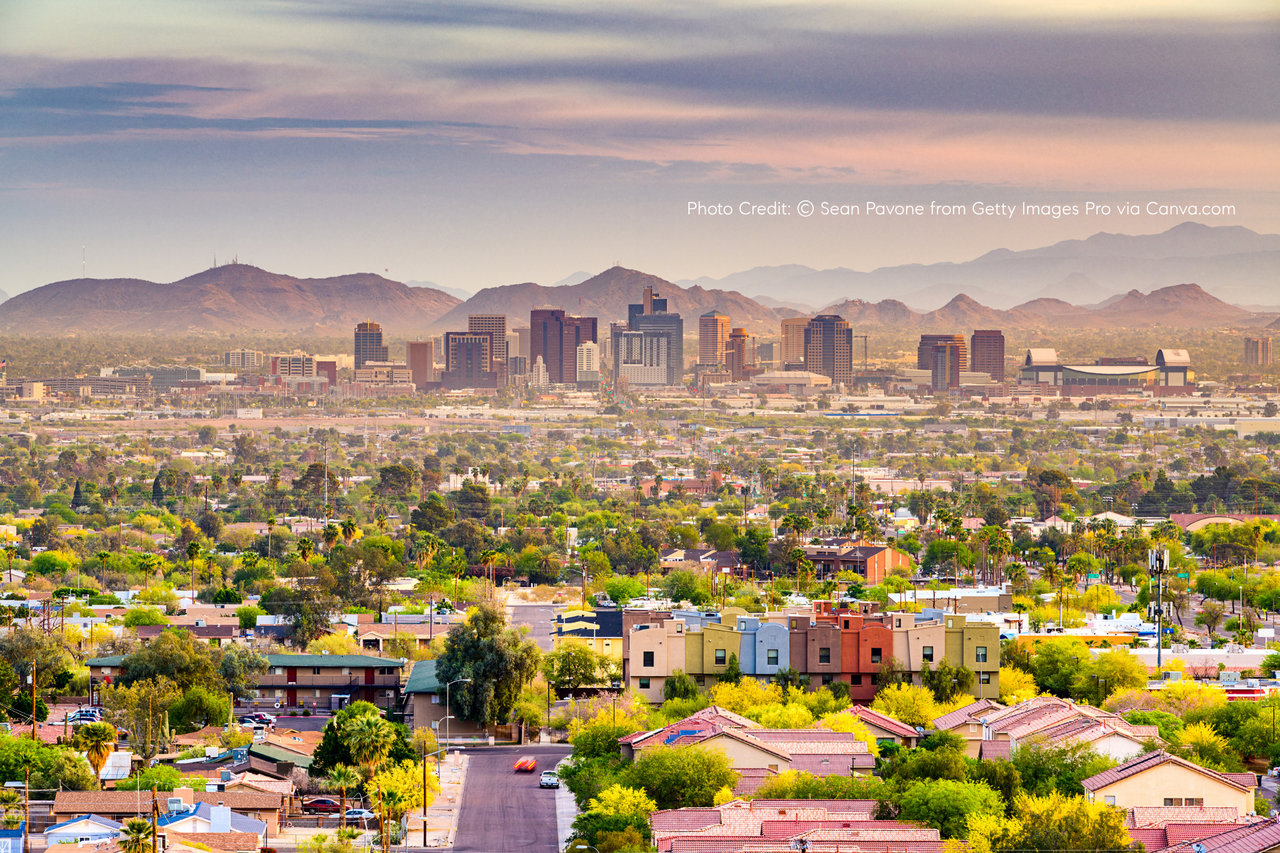
The “15-minute city” has become one of the most discussed urban planning frameworks in the country — and the conversation is gaining real traction in Phoenix.
At its core, the idea is simple: daily essentials — groceries, parks, schools, healthcare, fitness, dining — should be accessible within a 15-minute walk, bike ride, or transit trip. It’s not about eliminating cars. It’s about optionality. You can still drive — you just don’t always have to.
In Metro Phoenix, this shift is surfacing at the same time buyer priorities are evolving in measurable ways.
A Noticeable Shift in Buyer Behavior
Over the past 12–24 months, we’ve seen more buyers — particularly relocation clients and younger professionals — prioritize proximity over pure square footage:
-
Walkability
-
Transit access
-
Coffee, fitness, and dining within reach
“Location” is no longer just about the zip code. It’s about how efficiently life flows once you’re home. Buyers are increasingly asking:
-
Is there shaded pedestrian access?
-
Can I reach daily essentials without a 20-minute drive?
-
Is this near light rail?
-
Will this area feel more connected five years from now?
These micro-location dynamics are starting to influence showing activity, absorption rates, and long-term hold conversations.
Culdesac Tempe: A Real-World Test Case
One of the Valley’s most visible examples of 15-minute principles in action is Culdesac Tempe — a car-free, mixed-use community intentionally built adjacent to the Valley Metro light rail.
I visited recently and met Ryan, the developer, who walked me through the property. The experience is striking: a very, very European feel. Brightly colored murals, close proximity of housing, but nothing exactly the same in any individual area. The layout feels organic.
The shops are incredible small businesses, the kind you’d expect in an arts-focused neighborhood like Roosevelt Row — completely unseen elsewhere in Arizona. Narrow streets and reasonably tall buildings create immediate shade, while breezes flow naturally through the community. Leaving cars at the edge of the development is a brilliant touch, perfectly suited for desert living. It has a calm, relaxing vibe, reminiscent of Mediterranean pre-car communities — a true urban oasis in the Valley.
Culdesac Tempe prioritizes:
-
Walkable, shaded pathways
-
On-site retail and daily services
-
Heat-mitigation design
-
A “zero asphalt” layout
It’s not a blueprint for all of Phoenix, but it demonstrates an important principle: demand exists for connection-oriented design in a traditionally car-centric metro. Investors are watching closely.
Phoenix Isn’t Rebuilding — It’s Retrofitting
Unlike legacy East Coast cities, Phoenix won’t transform overnight. What’s happening is more strategic — layering walkability into targeted corridors.
1️⃣ ADUs & Gentle Density
Accessory Dwelling Units (casitas) and infill development expand housing supply without dramatically altering neighborhood character. This gentle density:
-
Supports neighborhood retail
-
Strengthens local micro-economies
-
Creates sustainable customer bases for small businesses
We’re already seeing increased investor interest in properties that allow ADUs, especially near transit corridors.
2️⃣ Light Rail Expansion as a Value Driver
Transit remains central to any 15-minute framework. The South Central Extension and Downtown Hub expansion strengthen the Valley Metro network, bringing connectivity to key corridors. Historically, rail expansion tends to attract:
-
Mixed-use development
-
Higher-density residential
-
Retail and restaurant clusters
-
Long-term appreciation pressure
In real estate terms, transit adjacency often shifts from convenience feature to valuation component.
3️⃣ Walkable Urban Code
Phoenix has implemented Walkable Urban Code zoning near light rail stations, encouraging:
-
Mixed-use vertical development
-
Shade-oriented design
-
Pedestrian-scaled streetscapes
-
Reduced parking dominance
Policy is quietly shaping future property performance.
4️⃣ Bike Infrastructure That Actually Functions
A 15-minute lifestyle only works if short trips feel safe and practical. Phoenix continues expanding protected bike infrastructure along key corridors, gradually converting “close enough” into “realistically accessible.” As connectivity improves, buyer perception follows.
What This Means for Phoenix Real Estate
When neighborhoods reduce dependency on long car trips, demand patterns shift. Connectivity becomes part of the home’s value. Proximity becomes a long-term hedge. Transit access becomes an investment lens.
We are seeing:
-
Stronger interest in properties within walking distance to light rail
-
Increased inquiry from out-of-state buyers familiar with walkable metros
-
More investor focus on mixed-use corridors
That said, growth will not be evenly distributed. Infrastructure investment is targeted. Some corridors will accelerate. Others will remain auto-dependent. Strategic positioning matters.
February Luxury Market Snapshot
February 2026 was yet another bumper month for extremely expensive homes.
-
Two homes sold for $20 million or more
-
Seven additional homes sold for more than $10 million
By comparison, February 2025 saw no homes sell for more than $15 million and only three over $10 million. The uber-luxury home market has trebled in unit totals and increased by 233% in dollar volume, from $37,150,000 to $123,750,000 (Source: Cromford Report).
This aligns with broader market trends:
-
In a K-shaped economy, high-income earners and asset-rich buyers drive sales at the top end
-
Buyers in lower and middle brackets remain cautious, suppressing volume in those segments
-
Monthly averages are skewed upward by luxury transactions, with average price per square foot less affected, but still influenced by mega-homes over 10,000 sq. ft.
The takeaway: luxury buyers are active, confident, and driving headline metrics, even as the rest of the market navigates uncertainty.
The Bigger Picture
Phoenix is not adopting a sweeping 15-minute mandate. Instead, it’s moving through incremental, practical adjustments:
-
Expanding transit corridors
-
Encouraging ADUs and infill
-
Implementing walkable zoning near stations
-
Designing for desert heat realities
-
Improving bike connectivity
Culdesac Tempe may be the headline. But the long-term story will be written by how effectively Phoenix aligns land use, transit, and lifestyle — especially in neighborhoods residents already value.
For buyers and sellers alike, the key question isn’t whether Phoenix becomes a 15-minute city. It’s which neighborhoods are quietly becoming one.
Curious which Phoenix neighborhoods are best positioned for long-term growth and connectivity? Reach out to David Newcombe for tailored insights, strategic guidance, and access to opportunities ahead of the curve.